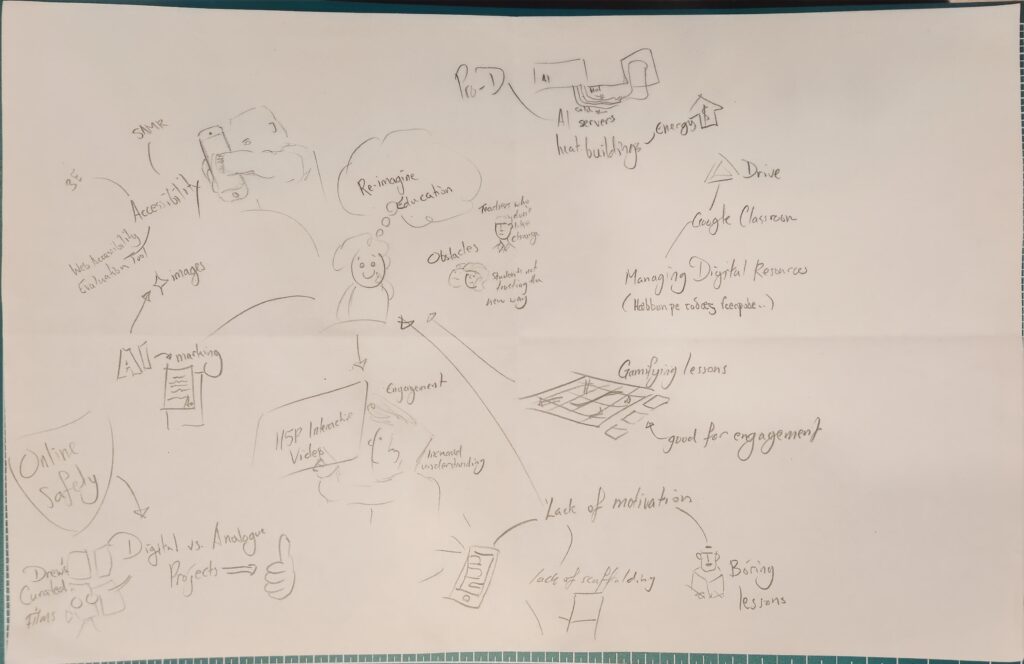
I am not a sketchnoter. That is not to say that I do not use pictures (doodles) in my notes, but I typically do not draw anything unless the lesson is incredibly boring or the content objectionable. I am pleased to say that there have been no doodles in my notes for EDCI 336!
This week, we watched the first batch of group presentations and also heard about Citizenship Online, Privacy, Safety, Bullying & Consent.
Group Presentations – Pods
The pods to which I was assigned before Friday’s class were:
Pod 4: Old vs New School Projects
Pod 11: Using Film in Classrooms
Pod 2: Using Stop Motion Animation to Support Multimodal Learning
Pod 15: Can teachers use Slido effectively to engage and help students learn?
My takeaways from these were that both digital and analog projects are useful depending on the context, film and stop-motion animation are useful for the engagement and that Slido was a resource that might be more trouble than it is worth for classroom use. I was impressed with Drew’s curated collection of films for classroom use, which he had organised according to the subjects in which they would be likely to be useful. I also liked the creative way in which Pod 4 presented their material.
Online Citizenship
This is mostly about online safety and online conduct. I conducted a Google search of my name and I was pleased to find that I am largely absent from the internet. There were few exceptions. I have a Facebook account, but it is private and I haven’t posted anything to it in years. My name appeared associated with UVic on ResearchGate and LinkedIn, but I have no posts. I have an X account, but I don’t follow anyone, don’t accept followers and I don’t post. I was surprised to find someone with a similar name to mine: Lindsey Leavitt Brown on Instagram @justanotherlindsey. While I used (early 2010s) to be more active online, these days I use Discord and WhatsApp and only sparingly.
For my children, we limit their screen time to a maximum of 30 minutes per day and they are only allowed to watch Korean content. They are not allowed to select the videos and they must watch it where we can see them. Regarding mobile phones, we may buy them a basic phone with which to call home, but we have decided that they may not have a smartphone until they are 18 and only if they buy it themselves. When I am teaching, I do not intend to make having a smartphone a prerequisite to success and I expect my children’s teachers not to make Chromebooks or phones essential either. My own parenting decisions notwithstanding, I can see that teaching students safe practice online is important where they have much broader access to social media.
Today, we did an EdCamp. This is where each of us proposed a topic that we would like to discuss, posting it to a board. We then voted by individually choosing three topics that most interested us. The 5 topics that received the most votes were selected for discussion and assigned to breakout rooms, after which we joined the breakout room of our choice and had a discussion.
I thought this was a very good way of having productive discussions, because it rather nearly guarantees there will be a topic that interests everyone and to which everyone will be comfortable contributing.
The discussion I joined was “Student Motivation and Reluctant Learners” which included the two main questions:
How would YOU approach a reluctant learner?
At what point do you think you should get the parents involved? What are some of the next steps?
Some of the reasons for a lack of motivation that were mentioned were the absence of higher education as a goal for some, the prevalence of smartphones both in and outside of class and lack of proper scaffolding. The lack of scaffolding stems from the gulf between the high expectations we have of students in secondary education and their actual ability and knowledge. We also considered the students are bored because of our boring lessons. My question related to this point was: “Would you watch a YouTube video of your lesson?”
When I was in Korea during the Covid pandemic, I had already been teaching at middle school for two years. As part of the remote learning, I had to make videos of all my lessons so that the students could access them on the school website. Making the lessons into videos showed me how boring my lessons were and forced me to make changes in order to make a lesson the students would actually watch. I radically rewrote all my material and I was much more effective and the students were much more engaged. They need to want to watch and take part.
This was a good experience and I would prefer this way of doing things whenever I have to take part in group discussions professionally.
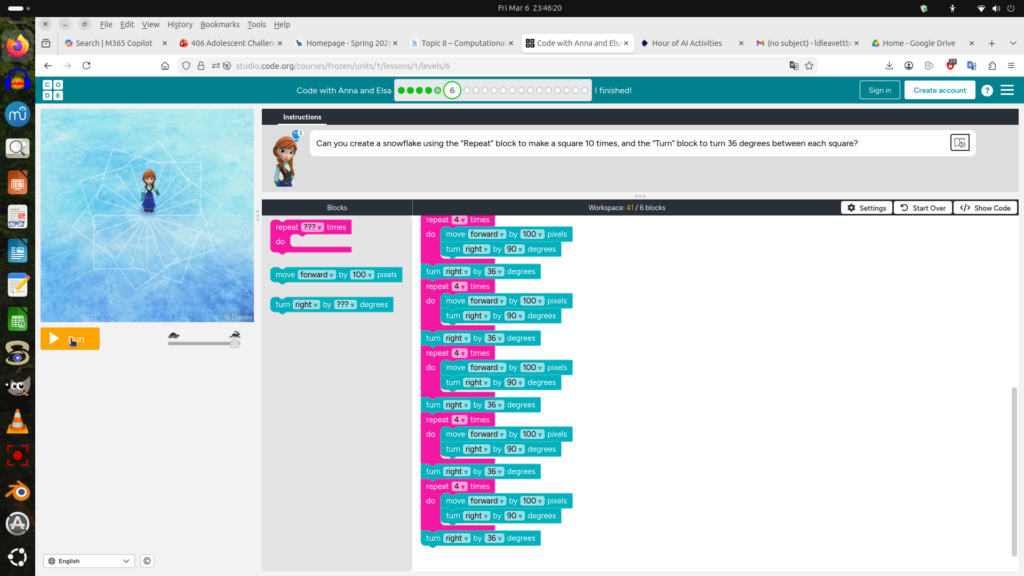
Probably not. I think that even with the simple stuff, there is quite a learning curve for me and I suspect that many of my students will be far enough ahead that any lesson I gave them on the subject would useless at best and laughably wrong at worst.
I wish that I were better. The blocks in the above screenshot did manage to complete the shape, but it still was not right and I have no idea why. I can see that the ability to code would be an asset and I am sure that in my teaching areas of Social Studies and English I could find a use for it. Perhaps some dull summer I shall get stuck into coding to try to make some game or activity for my class.
I like making games
I hate playing games. Sport bores me. I haven’t an jot of competitiveness in me. Games, however, are a fun way to teach things to secondary students. When I taught English in Korea, every lesson ended in a game. The mandate from the principal was to make English fun for the children and games were a big part of that.
I made my games enjoyable with a few techniques. First, I had a rotation of the types of games that I would employ: teacher-led, games played in groups (i.e., board and card games) and games that involved a lot of movement. Second, I tried to make it so that students felt that their decisions influenced the outcome of the game. This could be done by giving them choices, even blind choices, in the game. It could also be done by having success simply depend on how well they studied. Third, I liked to put surprises in the game. For instance, students would watch a video series, one episode per lesson. My games often had video clips from the series, edited to be amusing, so wrong answers would have the main character trapped in a block of ice, being fed to crocodiles or accidentally turning the queen into a harem dancer, Father Christmas or a flatulent little girl. I think these games effectively work as flash cards, but they are more engaging and, hopefully, more effective.
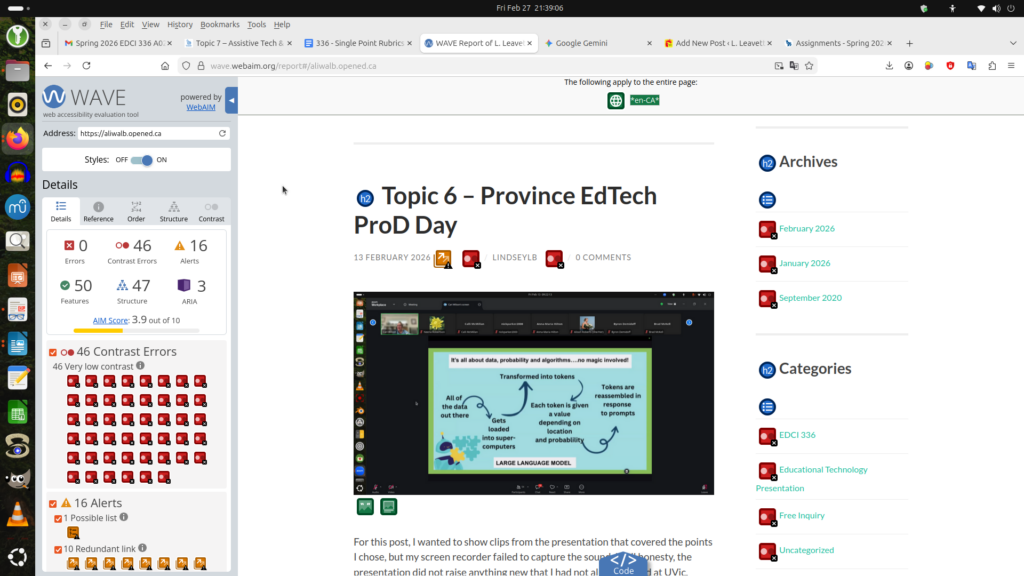
This week, we looked at making the content we produce more accessible. We also were introduced to a tool that allowed us to see how accessible our content is. This is the Web Accessibility Evaluation Tool. I used this tool on last week’s Reflection post, and found that I had received a 3.9 out of 10 as an Accessibility Impact score (AIM).
This picture is a screenshot of the WAVE report of last week’s Reflection post. It shows that I have a whole heap of deficiencies – bollocks!
This provided me with information that would be more useful if I knew how to change the colours of the hyperlink text. I tried; I failed. This also shows me that YouTube videos are not very accessible because the automatic captions are inaccurate. That may be true, but because editing captions is a lot of work for little reward, YouTube auto-captions must suffice.
SAMR and the Triple E Frameword
SAMR stands for Substitution, Augmentation, Modification, Redefinition and it is a tool for assessing new technologies do for education. The Triple E framework of Engage, Enhance and Extend is a way of determining the educational usefulness of a technology. Previously, I have used intuition and observation to see how useful I think a technology may be, but I can see this as a more scientific way to assess this.
The biggest failing that I see in presentations is that they often contain slides that are loaded with text and with visuals that are either absent or do not advance the message that is being presented. Last year, I endured a presentation by a guest speaker and it was the model of a poorly designed presentation. All the slides used an unchanging and monotonous Canva template and were filled with text that nobody read. It certainly didn’t help that the presenter delivered her talk in the dullest and flattest tone she could manage. I don’t remember anything from that presentation and I excused myself from the second half.
Why are accessibility practices not more widely used?
In the case I mentioned above, I believe that some teachers do not understand how to present what they are teaching in such a way as to make their audience receive it. We have not had a course that taught us about class management or how to put together and deliver a good presentation. It has been mentioned in passing in some of the courses, but never as the focus of the lesson. Teachers may also feel that finding relevant and useful visuals is more difficult than simply pasting their material onto a slide and then burbling away at their students. As for accessibility aids not being employed more generally, I believe that many people are not aware of the things that reduce the ability of students to access their content.
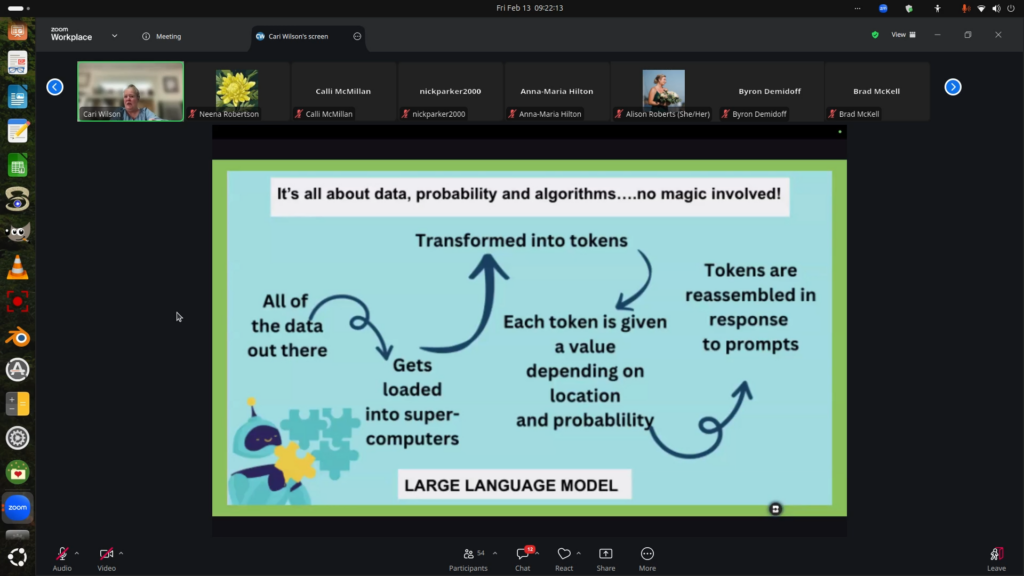
For this post, I wanted to show clips from the presentation that covered the points I chose, but my screen recorder failed to capture the sound. In all honesty, the presentation did not raise anything new that I had not already heard at UVic, except for some details that were mentioned in passing. The two points I wanted to cover were:
The use of AI servers to heat buildings; and
The resources that were provided at the end of the presentation.
AI Servers Heating Buildings
This is an interesting and seemingly intuitive way to use the heat that is produced by AI data centres. It turns the problem of excess heat into a money-making resource. This is an improvement on other solutions, such as building data centres under the sea in order to cool them. Such a use of the heat means that fewer resources are required overall. Because buildings are receiving their heat from this source, they do not have to waste the energy that they would have used if they employed a traditional method of heating. I was quite surprised at how much of America’s electrical power is from gas and coal. I was not surprised that electricity prices had risen near data centres, although I would not have guessed that it was 267% higher than five years ago.
I think that this technology is a great way to turn a problem into a boon. I do not see many problems with it except that, for heating, it would only be useful for those buildings that were close and that it would not be as useful when the data centres were located in a hot climate. Perhaps another way of using the heat as an energy source is possible in this situation.
The first link that Cari Wilson shared was to the Focused Education Resources page, which has resources, including slideshows and other tools. A quick look at the resource did not turn up anything that immediately struck me as the thing for which I had been yearning. There was no damascene moment, but I remain optimistic that, in time or with a deeper dive, I shall be able to find something useful. The problem for me is that I am looking for material that supports the things I want to teach, and I do not see anything that does that.
This is a slideshow for teaching about the impact of AI on the environment and on one’s health. The slides early in the presentation are good because they are not too text heavy. It rather lets itself down at the end in this regard. If I were to teach this as a lesson, I would want to rework all the slides in Google Slides or PowerPoint in order to make them more engaging.
I had a bit of a play with trying to get AI to generate an image. I found that Copilot was too restrictive. It would not let me generate the following image, which I had to use Gemini to create:
Gemini let me do this image, but would not animate it unless I had a subscription. It also could not add Rubio, Vance, Bessent, Lutnick and co. staring up at Trump sycophantically. I guess they know where their bread is buttered!
1. In the context of this program, I have found Generative AI useful for summarising readings. I am a slow reader and, when I started the program last September, I found that I was spending far too much time and absorbing far less of the information than I thought should. I found that having Gemini summarise the readings allowed me to quickly understand them and also have time to do my assignments.
2. Generative AI could be useful in a class setting for marking writing. I have found that I can be a little inconsistent with my marking as I get tired, which I think is unfair for my students. There is also the chance that I could miss things when I get near the end of a lot of marking, meaning that students are getting unequal service. AI could be useful for finding technical issues with a piece of writing, like with conventions or sentence structure, for instance. It could flag these things for me to look at to determine what corrections to make. I could prompt it to only flag the things that were taught in class so that I am not penalising students for things they have not learned. This would allow me to be fair with all my students and allow me to focus on the more creative aspects of their writing.
In today’s class, we covered the use of H5P to make interactive videos. I thought that this could be quite useful for maintaining students’ attention on the videos I publish and will also be a good way for students to monitor their own learning. I would probably not make the video using Zoom, partly because I am used to using other software for screen recording and also because I could not mute Zoom while I recorded my video and tried to figure out what I was supposed to do. I think it would be fun to test the limits of H5P to see if I could use it to make interactive games in the way I have done with PowerPoint:
I have found that students attend better to a lesson when they are not given the “death-by-PowerPoint” that comes from loads of text-heavy slides. I felt that the video by Dr Ray Pastore matched with what I have already learned through giving slide presentations. I think that the interactivity that he mentioned at the end of his video is important too. If there is nothing to which the students can interact, they may well disengage entirely. The age-appropriateness of this tool depends on what material is covered. The interactivity of the videos for most students may not be shared by students with disabilities. That being said, it is a useful tool and the use of interactive materials is supported in this article here:
I appreciated Sebastian’s YouTube hack of placing a – before the T in the web address to block the ads. This will help me when I am not at home and do not have my ad blocker.
Photo by Ben Wicks on Unsplash. Showing the punts at Quayside in Cambridge. These boats were my training for public speaking. These particular boats are lighter than the slightly larger “Baby Behemoths” that we also used at Scudamore’s.
Class Summary
Today, we discussed the documentary Most Likely to Succeed (2015) in breakout rooms. We also talked about privacy and the FIPPA, using creative commons and how to incorporate images in our posts and credit them, and about our projects with our learning pods.
Blog Prompts:
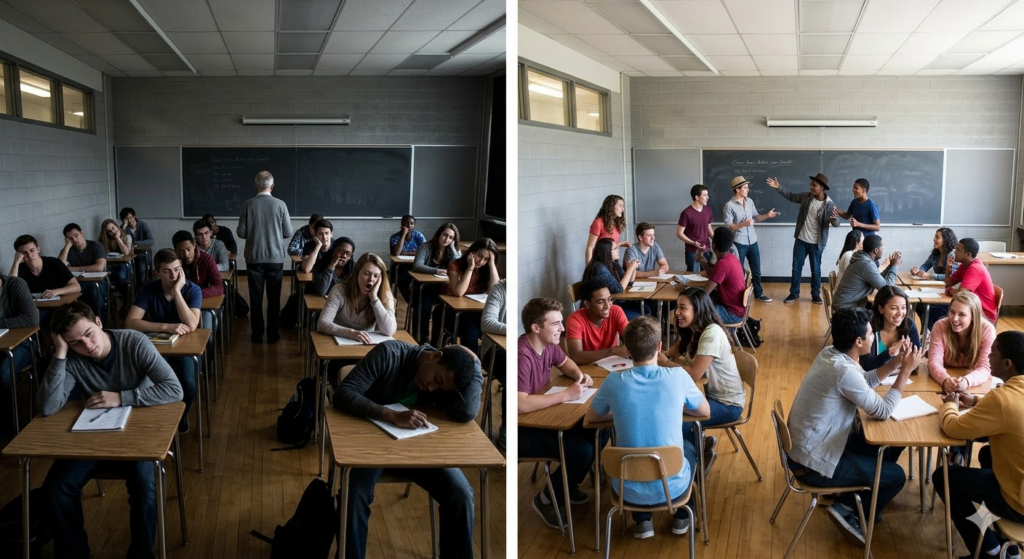
Do we need to re-imagine education?
Education should be adapted to prepare students for life in today’s world. Today’s world is constantly changing and change of how and what we teach students is necessary for their success. Wholesale, revolutionary change of how education is practised, however, is dangerous because of the risk of introducing untested and ineffective ways of teaching. The first students to be subjected to a new method may be let down by it. It is better to make incremental changes, discarding what is no longer effective and modifying useful practice to improve it. Additionally, as discussed in our break-out room, innovation is good, but not at the expense of core skills.
2. What obstacles to educators face when they try to change pedagogy?
Changing pedagogy is likely to meet resistance from parents and from teachers who are accustomed to the old way of teaching. Parents, who expect a letter grade rather than the proficiency scale, are frustrated when they are told that the letter grade is not the same thing. When their child comes home with a “proficient” grade, they understand it as a B and are frustrated when they see that their child has achieved a high score on their tests and assignments.
For teachers, discarding old ways of teaching that have worked well for them in the past, reworking whole units in order to make them conform to a new way and introducing methods that have not been proven or whose results are different from previous methods is a lot of work; a lot of work for something which may be discarded in turn when its efficacy is disproved. Incremental change is thus better than revolutionary change so that each modification can be seen as an improvement and not an upending of the system.
It is also likely that if a big change is seen to be political, it will meet resistance from those who are ideologically opposed to it. They will not see it as a way to more effectively teach and learn, but as a government-imposed brainwashing project. Incremental change is better.
3. Why is Privacy important in our classrooms?
Privacy is important in our classrooms because we are teaching minors. Any pictures published could be used by adult predators or by the students’ peers for bullying. Likewise, students’ work could be used to gather information on the students by outside actors to harm them. The students may also be inhibited if they know that everything they do is going to be released to the public. If embarrassing material (immature behaviour and opinions, and uncurated presentation, &c.) is released, it could follow them beyond the classroom and into later life. A dodgy statement made in jest could later ruin their career.
Before proceeding with this first blog post, we expect you to consider your privacy preferences carefully and that you have considered the following options:
Do you want to be online vs. offline?
Do you want to use your name (or part thereof) vs. a pseudonym (e.g., West Coast Teacher)?
Do you want to have your blog public vs. private? (Note, you can set individual blog posts private or password protected or have an entire blog set to private)
Have you considered whether you are posting within or outside of Canada? This blog on opened.ca is hosted within Canada. That said, any public blog posts can have its content aggregated/curated onto social networks outside of Canada.
First tasks you might explore with your new blog:
Go into its admin panel found by adding /wp-admin at the end of your blog’s URL
Add new category or tags to organize your blog posts – found under “Posts” (but do not remove the pre-existing “EdTech” category or sub-categories, Free Inquiry and EdTech Inquiry). We have also pre-loaded the Teacher Education competencies as categories should you wish to use them to document your learning. If you would like to add more course categories, please do so (e.g., add EDCI 306A with no space for Music Ed, etc.)
See if your blog posts are appearing on the course website (you must have the course categories assigned to a post first and have provided your instructor with your blog URL)
Add pages
Embed images or set featured images and embed video in blog posts and pages (can be your own media or that found on the internet, but consider free or creative commons licensed works)
Under Appearance,
Select your preferred website theme and customize to your preferences (New title, etc.)
Customize menus & navigation
Use widgets to customize blog content and features
Delete this starter post (or switch it to draft status if you want to keep for reference)
Do consider creating categories for each course that you take should you wish to document your learning (or from professional learning activities outside of formal courses). Keep note, however, that you may wish to use the course topic as the category as opposed to the course number as those outside of your program would not be familiar with the number (e.g., we use “EdTech” instead of “edci336).
Lastly, as always, be aware of the FIPPA as it relates to privacy and share only those names/images that you have consent to use or are otherwise public figures. When in doubt, ask us.
Please also review the resources from our course website for getting started with blogging: