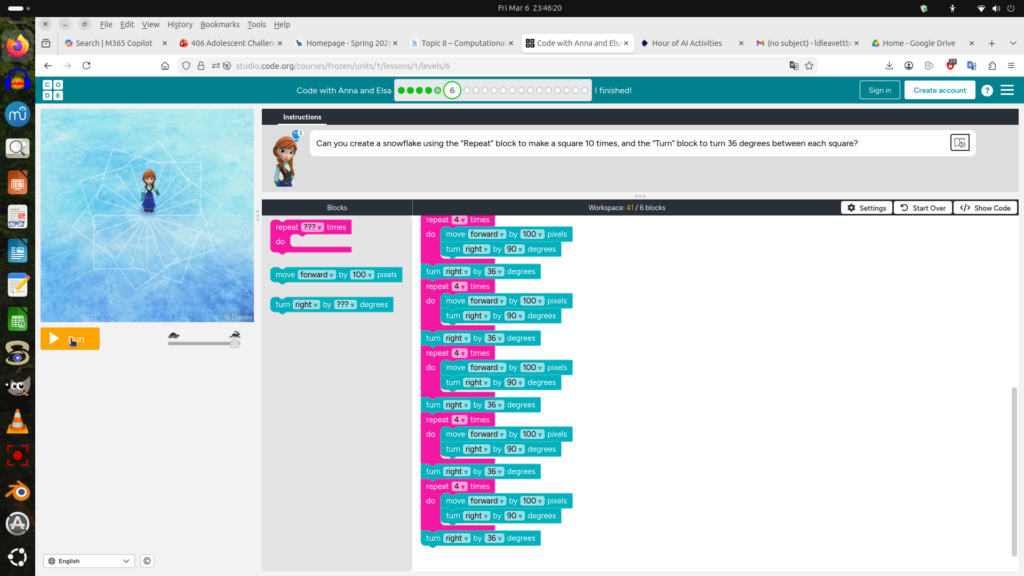
Shall I be using programming in the classroom?
Probably not. I think that even with the simple stuff, there is quite a learning curve for me and I suspect that many of my students will be far enough ahead that any lesson I gave them on the subject would useless at best and laughably wrong at worst.
I wish that I were better. The blocks in the above screenshot did manage to complete the shape, but it still was not right and I have no idea why. I can see that the ability to code would be an asset and I am sure that in my teaching areas of Social Studies and English I could find a use for it. Perhaps some dull summer I shall get stuck into coding to try to make some game or activity for my class.
I like making games
I hate playing games. Sport bores me. I haven’t an jot of competitiveness in me. Games, however, are a fun way to teach things to secondary students. When I taught English in Korea, every lesson ended in a game. The mandate from the principal was to make English fun for the children and games were a big part of that.
I made my games enjoyable with a few techniques. First, I had a rotation of the types of games that I would employ: teacher-led, games played in groups (i.e., board and card games) and games that involved a lot of movement. Second, I tried to make it so that students felt that their decisions influenced the outcome of the game. This could be done by giving them choices, even blind choices, in the game. It could also be done by having success simply depend on how well they studied. Third, I liked to put surprises in the game. For instance, students would watch a video series, one episode per lesson. My games often had video clips from the series, edited to be amusing, so wrong answers would have the main character trapped in a block of ice, being fed to crocodiles or accidentally turning the queen into a harem dancer, Father Christmas or a flatulent little girl. I think these games effectively work as flash cards, but they are more engaging and, hopefully, more effective.