My plan moving forward is to create the models that I shall use to build the animations. As I showed in the last post, the Bobo doll has been created, but I still need Dr Bandura, Mini-Me Dr Brown and two delinquent children. I have started my attempts at Dr Bandura but, so far, I am not satisfied. I started with a Goolge image search:
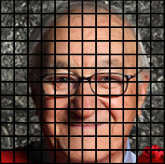
This provided me with plenty of pictures from different angles, but I have decided to start with the front. I took one of the portraits, straightened out the face and superimposed grid lines in Gimp.
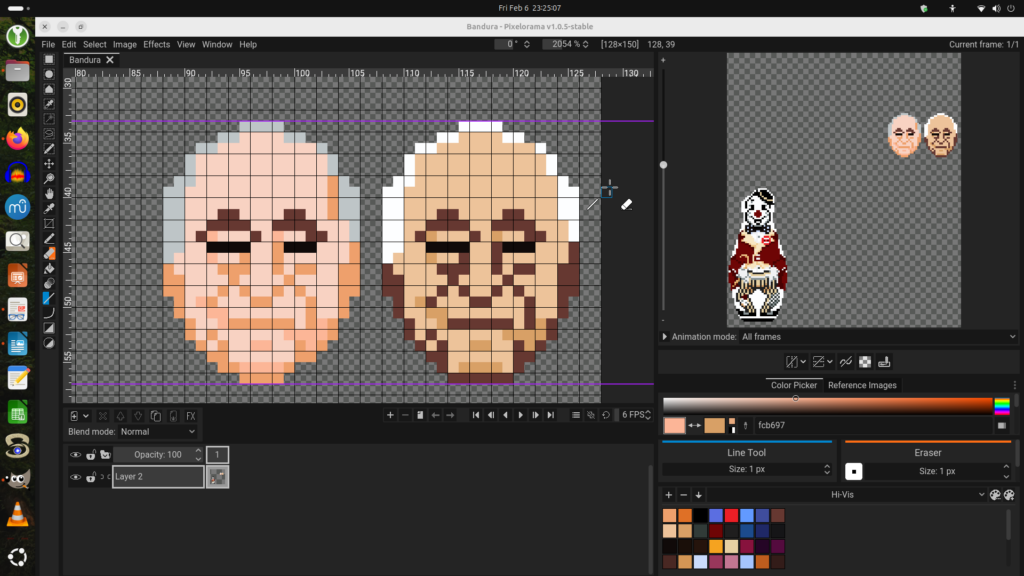
The grid squares represent 2×2 pixels on my Pixelorama canvas. I tried to recreate this as pixel art and I played with the colouring.
It is not a good likeness. The white-haired face is the original. The one on the left is where I tried to make the colouring closer to the original, but I think that it doesn’t look like anything when it is small: too indistinct. You can see the scale of it by comparing it to the Bobo doll where it appears in the preview window.
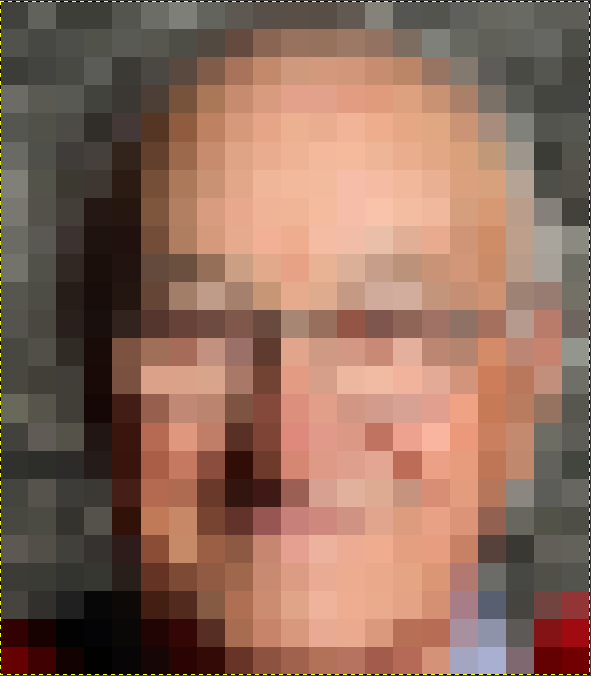
I thought that scaling down the original to the size of the pixel art might help. It has given me some ideas on how to move forward and it has also helped with the proportions, but I do not think a direct copy is desirable. The face needs to be slightly cartoony for it to be recognisable as a face at this size. Also, the complex colouration of the photograph would require a lot more work to animate with little reward.
I could only get the pixels to be distinct viewing it through the Gimp editing software and making a screenshot. Image viewers tend to blur the pixels together.
Today, we looked at ways of keeping track of digital resources and curating content. The resource I am most likely to use is Google Keep, because it is part of the Google suite of apps that I already use. That being said, I tend to use Google Calendar for scheduling and the Notes app on my phone for keeping track random information, so Google Keep and similar software serve to fill a need that I do not have.
Currently, I frequently use Google Drive to hold materials that I have created. I started using this when I was in Korea and was sharing lessons a games that I had created. I posted links to them in the (now defunct) waygook.org forum for fellow ESL teachers to download. I have used Microsoft Copilot for this recently, but I find that the sharing of files is not as easy.
Google Classroom is certainly a tool that I would like to use. It is something that I shall have to look at more closely during reading break. I believe that it will be most useful to me for posting assignments and keeping parents informed. I am a little worried that it might be seen by others as a way for them to have round-the-clock access to me.
This is how Gemini improved what I wrote:
Reflection on Digital Resource Management
Today’s session focused on various methods for tracking digital resources and curating educational content. While exploring several platforms, I found Google Keep to be the most practical option due to its seamless integration with the Google Workspace apps I currently employ. However, since I already utilize Google Calendar for scheduling and a native mobile application for miscellaneous notes, Google Keep occupies a niche that—for my current workflow—is already largely addressed.
Current Workflow and File Sharing
Presently, I rely heavily on Google Drive to manage and store my instructional materials. This practice originated during my time teaching in Korea, where I shared lesson plans and educational games with the ESL community via the waygook.org forum. While I have recently experimented with Microsoft Copilot for similar tasks, I have found its file-sharing capabilities to be less intuitive than those offered by the Google ecosystem.
Future Implementation: Google Classroom
I am keen to integrate Google Classroom into my professional practice and intend to explore its features more thoroughly during the upcoming reading break. I anticipate it will be an invaluable tool for:
Distributing and managing student assignments.
Maintaining transparent communication with parents.
Despite these advantages, I do harbour some reservations regarding work-life boundaries. I am concerned that adopting such a platform might inadvertently create an expectation of “round-the-clock” availability to students and their families.
Here it is in Old English:
Hæbbun wē tōdæg scēawode hū mann mæg his hord gegaderian and his bōccræftas wel healdan.
Þone cræft þe ic mæst lufie is Google Keep, for þæm þe hē is dæl þæra tōla þe ic ǣr gearwode.
Swā þēah, ic brūce mīnes dægrīmes tō tīde weordunge, and ic wrīte mīne lytlan ǣrendgewritu on mīnum sēolfontācnunge; for þon ne þearf ic þone nīwan cræft tō þissum þingum.
Nū brūce ic Google Drive oft, þǣr ic mīne lār-timber healde.
Ic angann þis tō dōnne þā ic wæs on Corealande, and ic dælde mīne lāra and mīne plegan mid ōðrum gōdum mægestrum on þæm brādum folc-stede Waygook.
On þissum dagum hæbbe ic Microsoft Copilot fandode, ac mē þyncþ þæt þā gerynu nē synt swā ēaþe tō dælenne swā on þæm gōdan Google.
Google Classroom is sōðlīce tōl þone ic wille lurnian.
Ic sceal þæt gēorne scēawian on mīnre ræding-reste.
Ic gelīefe þæt hit biþ mē swīðe gōd tō rædenne þā weorc þāra cilda and tō cȳðenne þone mægeþ-rǣd þæm fæderum and mōdrum.
Ac mē is sum lytel drēdrǣd on mōde: þæt mænigfeald fole wēne þæt hīe mægen mē findan and mid mē sprecan on ǣlcre tīde, gē on dæge gē on nihte.
I had a bit of a play with trying to get AI to generate an image. I found that Copilot was too restrictive. It would not let me generate the following image, which I had to use Gemini to create:
Gemini let me do this image, but would not animate it unless I had a subscription. It also could not add Rubio, Vance, Bessent, Lutnick and co. staring up at Trump sycophantically. I guess they know where their bread is buttered!
1. In the context of this program, I have found Generative AI useful for summarising readings. I am a slow reader and, when I started the program last September, I found that I was spending far too much time and absorbing far less of the information than I thought should. I found that having Gemini summarise the readings allowed me to quickly understand them and also have time to do my assignments.
2. Generative AI could be useful in a class setting for marking writing. I have found that I can be a little inconsistent with my marking as I get tired, which I think is unfair for my students. There is also the chance that I could miss things when I get near the end of a lot of marking, meaning that students are getting unequal service. AI could be useful for finding technical issues with a piece of writing, like with conventions or sentence structure, for instance. It could flag these things for me to look at to determine what corrections to make. I could prompt it to only flag the things that were taught in class so that I am not penalising students for things they have not learned. This would allow me to be fair with all my students and allow me to focus on the more creative aspects of their writing.
In today’s class, we covered the use of H5P to make interactive videos. I thought that this could be quite useful for maintaining students’ attention on the videos I publish and will also be a good way for students to monitor their own learning. I would probably not make the video using Zoom, partly because I am used to using other software for screen recording and also because I could not mute Zoom while I recorded my video and tried to figure out what I was supposed to do. I think it would be fun to test the limits of H5P to see if I could use it to make interactive games in the way I have done with PowerPoint:
I have found that students attend better to a lesson when they are not given the “death-by-PowerPoint” that comes from loads of text-heavy slides. I felt that the video by Dr Ray Pastore matched with what I have already learned through giving slide presentations. I think that the interactivity that he mentioned at the end of his video is important too. If there is nothing to which the students can interact, they may well disengage entirely. The age-appropriateness of this tool depends on what material is covered. The interactivity of the videos for most students may not be shared by students with disabilities. That being said, it is a useful tool and the use of interactive materials is supported in this article here:
I appreciated Sebastian’s YouTube hack of placing a – before the T in the web address to block the ads. This will help me when I am not at home and do not have my ad blocker.
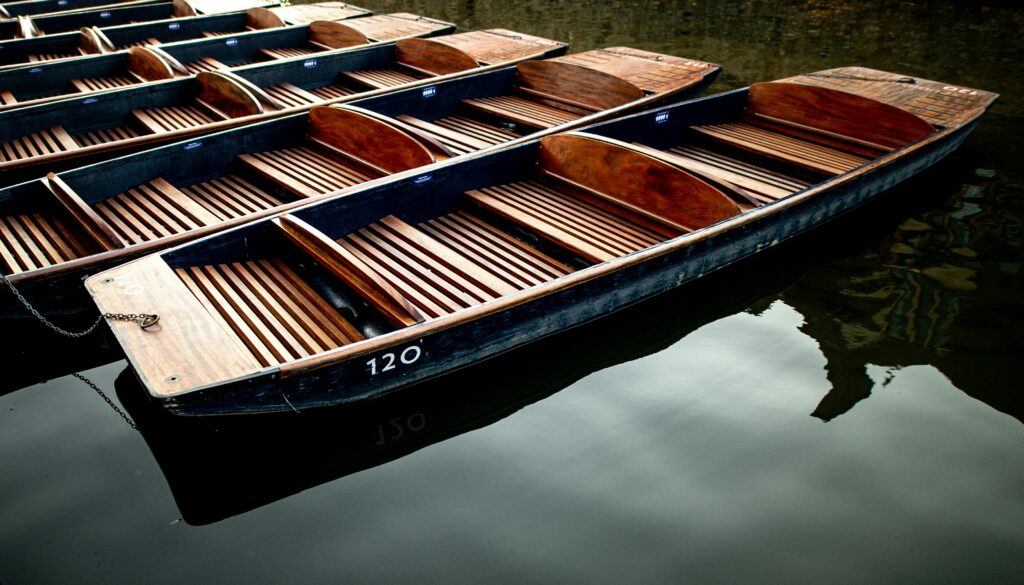
Photo by Ben Wicks on Unsplash. Showing the punts at Quayside in Cambridge. These boats were my training for public speaking. These particular boats are lighter than the slightly larger “Baby Behemoths” that we also used at Scudamore’s.
Class Summary
Today, we discussed the documentary Most Likely to Succeed (2015) in breakout rooms. We also talked about privacy and the FIPPA, using creative commons and how to incorporate images in our posts and credit them, and about our projects with our learning pods.
Blog Prompts:
Do we need to re-imagine education?
Education should be adapted to prepare students for life in today’s world. Today’s world is constantly changing and change of how and what we teach students is necessary for their success. Wholesale, revolutionary change of how education is practised, however, is dangerous because of the risk of introducing untested and ineffective ways of teaching. The first students to be subjected to a new method may be let down by it. It is better to make incremental changes, discarding what is no longer effective and modifying useful practice to improve it. Additionally, as discussed in our break-out room, innovation is good, but not at the expense of core skills.
2. What obstacles to educators face when they try to change pedagogy?
Changing pedagogy is likely to meet resistance from parents and from teachers who are accustomed to the old way of teaching. Parents, who expect a letter grade rather than the proficiency scale, are frustrated when they are told that the letter grade is not the same thing. When their child comes home with a “proficient” grade, they understand it as a B and are frustrated when they see that their child has achieved a high score on their tests and assignments.
For teachers, discarding old ways of teaching that have worked well for them in the past, reworking whole units in order to make them conform to a new way and introducing methods that have not been proven or whose results are different from previous methods is a lot of work; a lot of work for something which may be discarded in turn when its efficacy is disproved. Incremental change is thus better than revolutionary change so that each modification can be seen as an improvement and not an upending of the system.
It is also likely that if a big change is seen to be political, it will meet resistance from those who are ideologically opposed to it. They will not see it as a way to more effectively teach and learn, but as a government-imposed brainwashing project. Incremental change is better.
3. Why is Privacy important in our classrooms?
Privacy is important in our classrooms because we are teaching minors. Any pictures published could be used by adult predators or by the students’ peers for bullying. Likewise, students’ work could be used to gather information on the students by outside actors to harm them. The students may also be inhibited if they know that everything they do is going to be released to the public. If embarrassing material (immature behaviour and opinions, and uncurated presentation, &c.) is released, it could follow them beyond the classroom and into later life. A dodgy statement made in jest could later ruin their career.